
The Infinite Menu

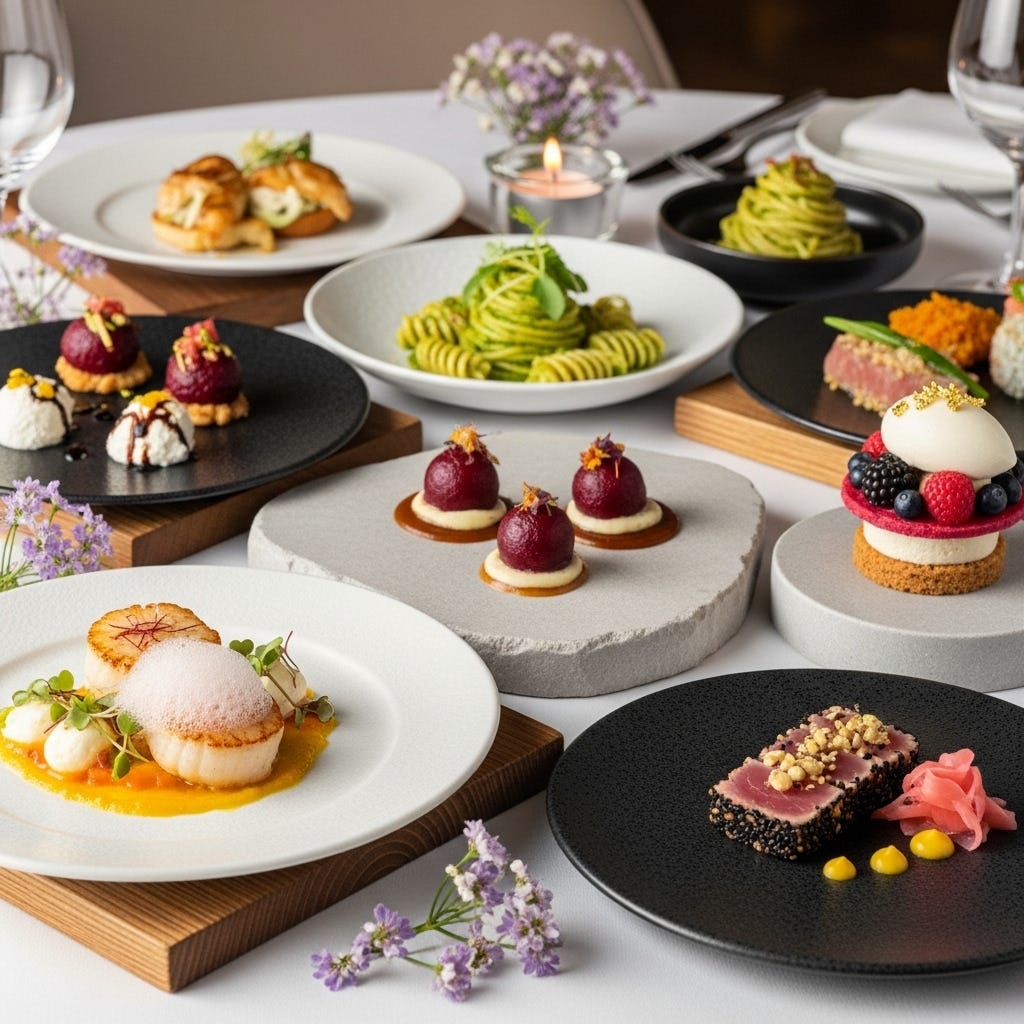
Restaurant dining is not aligned with the nature of human hunger.
The fixed-portion menu is anti-human because appetite does not play by set amounts. Menus are stiff.
Imagine if you could dial in the quantity of each menu item as easy as moving a slider:
“Give me 0.7 of the risotto.”
“Let’s do 1.2 of the scallop tartare.”
“Just a 0.3 of that signature dessert, enough to taste.”
You could eat to perfect fullness and satisfaction, and there would be no waste. You’d have the freedom to compose your meal as a landscape of tastes.
There’s something profound about being able to say, “This is exactly what I want and need, no more, no less.”.
But not every dish is so easily divisible. So how does one approach this?
Every dish has an essence. A dish with featuring lobster could become lobster croquette/emulsion/bisque, each, sat one “one-tenth” the experience, and you order as many as you like.
Pull this off and you stand alone in gastronomy as one who truly serves the eater, not the kitchen.
The status quo is designed around the kitchen’s production logic and the arbitrary “portion” as dictated by tradition, cost, and convenience.
But human hunger is personal. It’s in flux with mood, company, even weather. A person needs direct authorship over their own satisfaction.
Why shouldn’t you be able to dial in a meal like tuning an instrument? “Tonight I’m a 1.3 on the gnocchi, but only a whisper of the lamb.”
Small-plate concepts like tapas, izakaya, dim sum exist but are precise enough. No one is free to say “give me 0.4 of the braised eggplant.”
Software is fit to handle the complexity of dynamic portioning.
There is indeed a rise of tasting menus, but even those are dictated, not chosen.
The real game-changer is not dish into 10ths, but distilling its soul into modular, divisible experiences.
A lobster dish becomes three micro-forms: croquette, bisque, mousse, each representing a slice of the whole lobster idea.
The risotto becomes a tasting spoon, a half-portion, a full bowl and each is fully realized.
The dessert is not just a bite but an intentional essence-serving.
A chef would need to rethink dish design so every portion is complete on its own rather than being a mere piece.
The question is not “what are the main courses?” but rather “what landscape of tastes and fullness do I desire?”.
Pull this off and you’re a pioneer because you treat taste and hunger as a continuum.
Never stuffed, never wishing you had just a little more of something. The conversations it would start in gastronomy.